
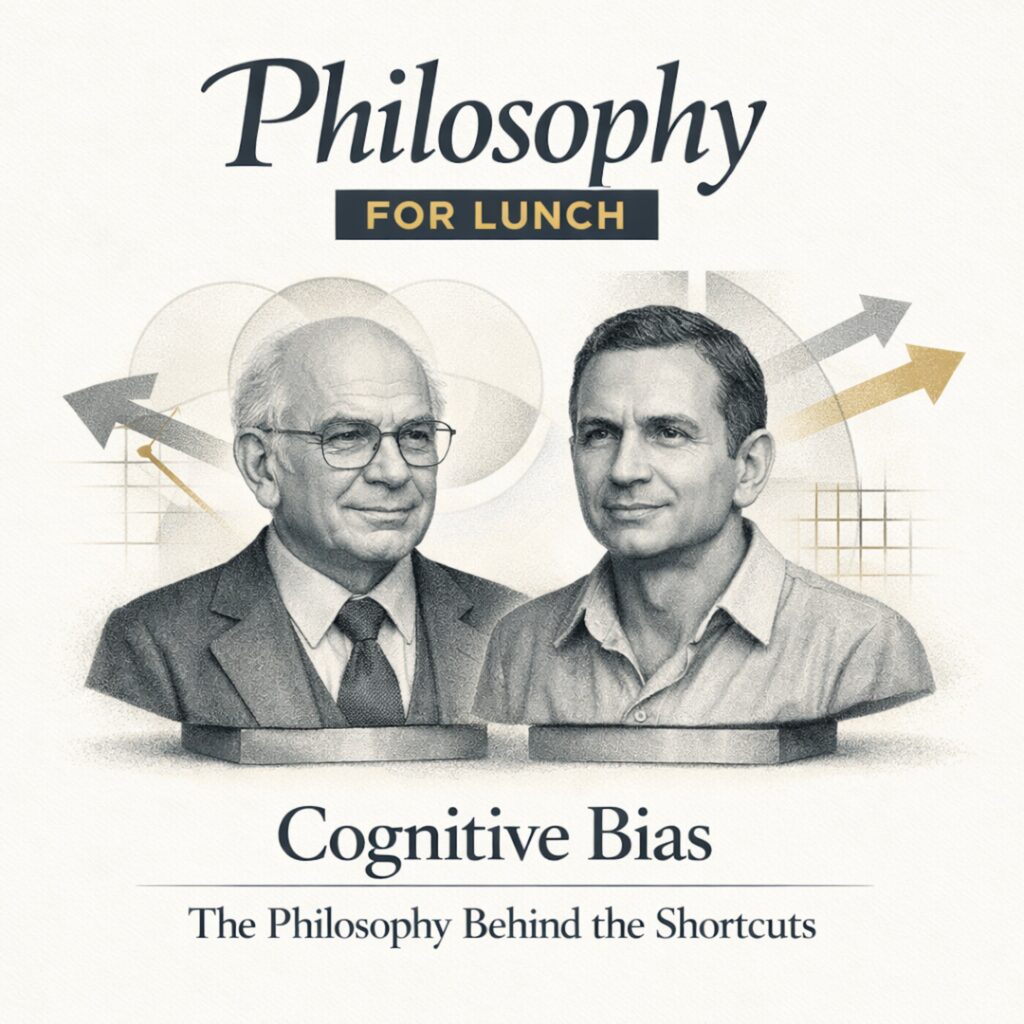
Episode notes:
You think you know why you believe what you believe. You probably do not.
Not because you are careless or unintelligent, but because the part of your mind doing most of the work is fast, automatic, and largely invisible to you. It forms judgments before you are aware of them, fills in gaps with whatever is most available, and produces confident outputs without flagging what it missed. And here is the uncomfortable part: learning about this does not reliably fix it.
In this episode, Shawn and Claire open Block Two — How We Think — with the most practically disruptive idea in modern psychology. Drawing on Daniel Kahneman’s and Amos Tversky’s decades of research, they walk through the architecture of System 1 and System 2 thinking—not as a memorizable list of named errors, but as a philosophical framework for understanding why the mind works the way it does and what that means for how we should live.
This episode goes further than the popular Kahneman summary. It asks the questions that the pop-psychology version leaves out: If our moral judgments about other people are shaped by biases we cannot see — by race, by attractiveness, by how a question is framed — what does that mean for ethics? If knowing about a bias does not protect you from it, what actually helps? And is there something right about the shortcuts, or are they simply errors in a system that should know better?
They also cover the philosophical tension at the heart of nudge theory—the insight that you can improve decisions not by educating people but by changing the architecture of their choices and why that approach is both effective and deeply uncomfortable from the standpoint of human autonomy.
The examined life is still the goal. But this episode shows just how much there is left to examine.
Shawn and Claire together. No prior knowledge required.
SHOW NOTES
Primary Works
- Kahneman, D. (2011). Thinking, Fast and Slow. Farrar, Straus and Giroux.
- Tversky, A., & Kahneman, D. (1974). Judgment under uncertainty: Heuristics and biases. Science, 185(4157), 1124–1131.
- Kahneman, D., & Tversky, A. (1979). Prospect theory: An analysis of decision under risk. Econometrica, 47(2), 263–291.
Works Referenced in This Episode
- Gigerenzer, G. (2007). Gut Feelings: The Intelligence of the Unconscious. Viking.
- Mercier, H., & Sperber, D. (2017). The Enigma of Reason. Harvard University Press.
- Thaler, R. H., & Sunstein, C. R. (2008). Nudge: Improving Decisions About Health, Wealth, and Happiness. Yale University Press.
- Greenwald, A. G., McGhee, D. E., & Schwartz, J. L. K. (1998). Measuring individual differences in implicit cognition: The implicit association test. Journal of Personality and Social Psychology, 74(6), 1464–1480.
- Wason, P. C. (1968). Reasoning about a rule. Quarterly Journal of Experimental Psychology, 20(3), 273–281.
Accessible Starting Points
- Lewis, M. (2017). The Undoing Project: A Friendship That Changed Our Minds. Norton. (The story of Kahneman and Tversky’s collaboration — reads like a thriller.)
- Ariely, D. (2008). Predictably Irrational: The Hidden Forces That Shape Our Decisions. HarperCollins.
New episodes every Sunday. Philosophy for Lunch · Big ideas. Human conversations.